Legend Of Tomte

This is for all who are not aware of the fabulous tomte and his legend…….
Tomte (Swedish) or Tonttu (Finnish, also called Nisse in Norway) are solitary, mischievous domestic spirits, responsible for the protection and welfare of homes and stables, farms and their buildings.
Tomte are folklore creatures, originally believed to stem from the soul of the first farm owner of each farm, then becoming a spirit figure, ensuring the farm’s continuous care. Tomte have a love for tradition, they don’t like change. They sleep underneath the floorboards most of the year and appear during night time towards Christmas. They are ancestral figures demanding respect, attention, care and a lot of love, and in return they help keep the house and outhouses in good condition, especially helping to prepare the house and stables for the Christmas festivities.
Farms in previous centuries were often isolated, people lived through long, dark winters, hence the tomte figures sprang from the imagination and became companions to keep solitude at bay.
Tomte literally means ‘homestead man’ and is derived from the word ‘tomt’ which means homestead or plot of land. Nisse, as he is called in Norway, sprung from the name Nils, which is the Scandinavian form of St. Nicholas.
A Tomte is described as a little elderly man, three feet high, with a long, white beard, wearing grey, brown or navy clothes with traditional boots plus sporting a bright red cap. There are different dress codes for the different types of tomte. The ones living in the stables with the animals wear mostly grey clothes while the ones in the main house are dressed more neatly, combining some colour such a yellow, green and blue with the red hat.
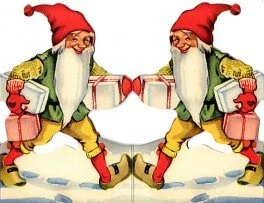
There are Tomte residing in the pantry and the barn, watching over the household and farm. They are responsible for the care of the house and farm animals, especially the much valued horses. The tomtes have an enormous capacity for work but will not tolerate anyone’s interference. A sure way to offend a tomte is rudeness. maids or farm workers swearing, dirty outhouses and stables, or not treating animals well, are all things that would incur tomtes’ disapproval, so it's paramount keeping all premises neat and orderly for not getting nasty surprises played out by the little creatures.
The same would apply to the main house and if anyone spilled anything on the floor of the house, it was advised to shout a warning to tomte so that he wouldn’t fall into the puddle. Again, if he would be offended in any way, he could play all kinds of pranks, such as binding all cows’ tails together, hiding objects or breaking favourite things.
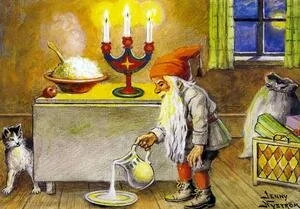
It is believed that a clean and orderly home and farm is an indication that a good domestic tomte spirit resides there. Keeping the tomte figurtes happy was paramount and when people moved from the countryside into the cities they brought their tomte with them. Also here, he sleeps under the floorboards during the warm months, starting to wake up when the days are getting short and cold. Towards December he starts preparing the home for Christmas, cleaning, washing, ironing, preparing all Christmas food, baking and sweets making. His presence is very much cherished by city dwellers and country folks alike, as it is fortunate to have an able Tomte in ones home.
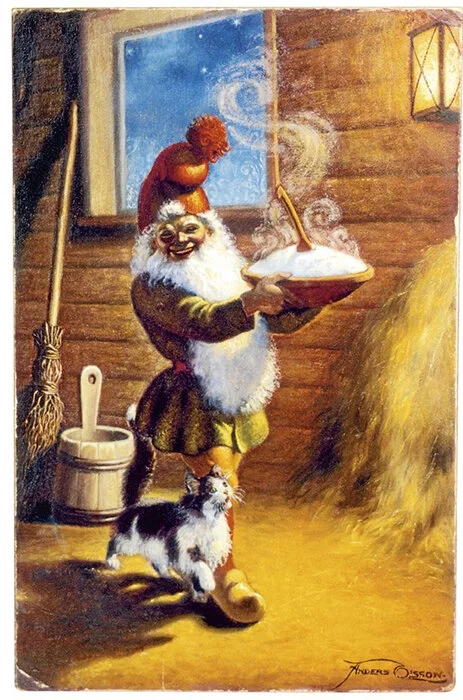
Tomtar require very little from people they work for. They demand only the respect and trust of the homeowner and a bowl of ‘julgröt’, Christmas porridge with butter for Christmas eve. It is a simple request but expected to be executed to perfection. A Tomte considers porridge his due and loves butter. In the old days, butter was a luxury, consumed only on special occasions. The tale of the tomte who got no butter on his Christmas porridge, illustrates the consequences for tampering with his favourite meal.
Legend has it that one Christmas eve, a servant girl decided to play a trick on tomte. She hid the butter for his porridge at the bottom of the bowl. When tomte saw, there was no butter on his Christmas porridge, he went to the shed and killed the best cow. He wanted to show them is importance, that he did not appreciate being begrudged a little bit of butter. Anyhow, he returned to the barn to eat the porridge anyway. When he discovered the butter at the bottom of the bowl, he felt so bad that he walked to the neighbour’s farm, took their best cow and led her back to the stable of his patron. According to folktales, domestic spirits often steal from a neighbour to increase the prosperity of the farm where they made their home. This is demonstrated in one of the classic stories ‘Tomte who stole fodder’.
The spirit of the tomte is still very much alive today, both in towns and in the countryside. He is a welcome, invisible companion when the days are getting darker and longer and one has to start all the many preparations for Christmas. From the tomte figure, the Scandinavians adopted the St. Nicolas figure or the popular representation of Father Christmas (as introduced by Coca Cola in their early advertising). Here our tomte is portrayed as an older, good natured, adult-sized man (unsurprisingly the size of an uncle or father) with a long white beard and a red hat and suit. He carries a sack of toys on his back and visits children in their homes on Christmas Eve. Many believe Father Christmas lives at the North Pole, where he has his workshop.
Tomte is so dear to Scandinavian hearts that the romantic Swedish novelist Victor Rydberg has written a poem in his honour, published 1881. Here the tomte is alone and awake on Christmas night is pondering over the mysteries of life and death. This poem was illustrated by the very popular artist Jenny Nyström (around 1885), who with her romantic creations, triggered the fantasies of young and old.
We will always cherish the tomte as it keeps our spirits up during the dark winter nights leading up to Christmas. And we like a helping hand preparing the house for the festive Christmas celebration. It's reassuring to know, tomte helps with preparations during the night, busy cleaning the house and stables, baking and making, preparing food and packing presents, no wonder he is so much loved.

Only tomten is awake......
Midwinter night's cold is hard, stars glimmer and gleam. All sleep in quiet yard, deep in a midnight dream. Snow shines white on fence and spruce, moon beams bright on snow-capped roofs. Hush fills a forest near a frozen lake, only tomten is awake.
Short poem version by Victor Rydberg - Wishing everyone a very happy Christmas!